Where to Stay in London for First-Timers: 7 Best Areas & Hotels We’d Pick
This post may contain affiliate links, including from Amazon and other trusted partners. If you click a link and make a purchase, we may earn a small commission at no extra cost to you. That said, we only recommend products and services we genuinely use and love. Learn more in our Privacy Policy page.


London is one of those cities where picking the wrong area or the wrong hotel can genuinely ruin your trip. Two places on the same tube line, just a few stops apart, can feel completely different… and not always in a good way.
If you're planning your first visit and don't want to waste time or money in the wrong neighbourhood or hotel, this guide will help you narrow it down quickly.
We've spent ten years living in London across different stints. We've stayed in more than 30 London hotels ourselves (for anniversaries, birthdays, work trips, moving flats, and more) and visited several to assess them for this blog.
We also get regular feedback from our readers who've used our guides, which helps round out the picture, especially for places we haven't personally tested yet.
In this post, we've narrowed London down to the seven areas we'd recommend for a first trip (South Bank/Southwark is our absolute favourite), with three hotel picks for each neighbourhood across different budgets. A few popular areas didn't make the list, and we'll explain why at the end.
One thing we'd say upfront: book early! London is one of the most expensive hotel cities in the world, and the best-value options go quickly. The difference between booking early and leaving it too late can easily be hundreds per night.

Just need a hotel you can't go wrong with?
Our personal London hotel picks
Quick comparison of London's best areas to stay
Prefer to choose by area? All seven neighbourhoods below work well for a first trip, and you really can't go wrong with any of them.
But South Bank/Southwark gets our top spot because nowhere else packs this much into a single walk: world-class art, two brilliant food markets, and the river right on your doorstep. It also tends to be better value than the West End for similarly central hotels, and noticeably quieter at night.
Here's how each area compares, plus the hotel we'd pick:
Scroll right to see the entire table >>
|
Area |
Best for |
Vibe |
Our hotel pick |
|---|---|---|---|
|
South Bank & Southwark (our #1 pick ⭐) |
Foodies, first-timers, riverside walkers |
Scenic, cultural, buzzy |
|
|
Westminster |
Sightseers, history lovers, landmark hunters |
Grand, iconic, tourist-heavy |
|
|
Covent Garden |
Theatre-goers, shoppers, night owls |
Lively, central, entertaining |
|
|
South Kensington |
Museum lovers, culture seekers |
Elegant, leafy, upscale |
|
|
City of London |
Architecture fans, free rooftop lovers, weekend visitors |
Polished, historic, quiet on weekends |
|
|
Shoreditch & Spitalfields |
Creative types, nightlife seekers, market lovers |
Edgy, youthful, independently minded |
|
|
Bloomsbury & Fitzrovia |
Museum-goers, foodies, readers |
Calm, central, understated |
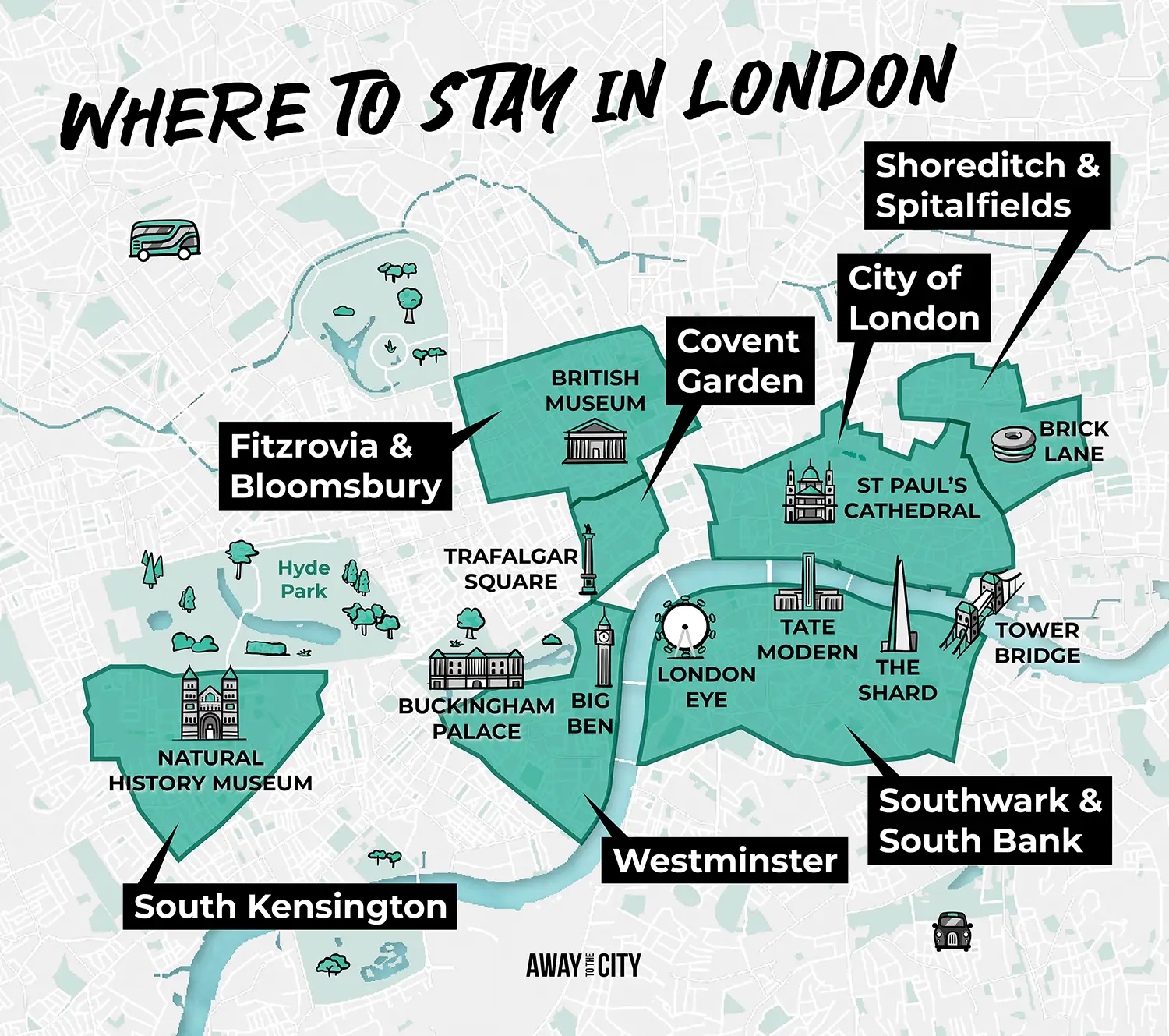
Below, you can see our favourite neighbourhoods for first-timers on our illustrated map:
1. South Bank/Southwark
Best area for: riverside walks, iconic skyline views, and great food markets.
Pros
Cons
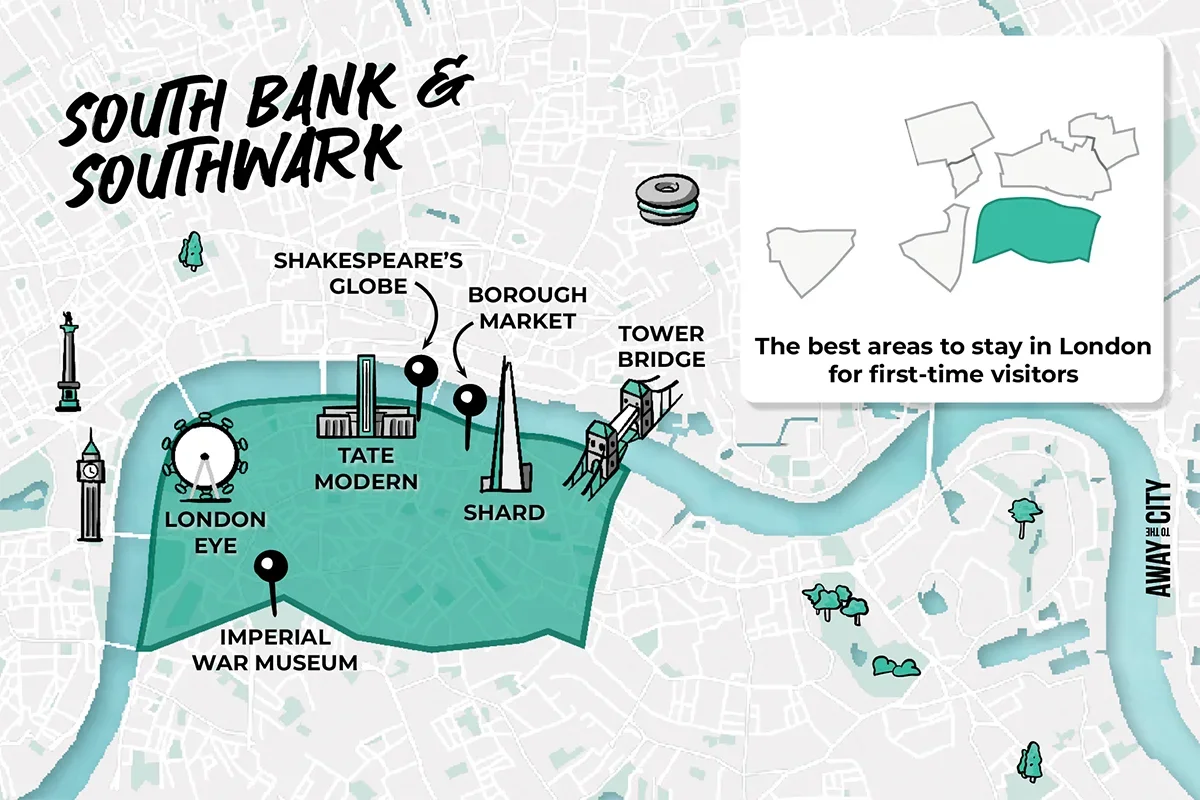
A lot of London visitors immediately cross South Bank and Southwark off their list because they assume anything south of the river is too far out. It isn't.
You're just one bridge crossing away from the centre, and in our opinion, this is THE best area to stay in London for first-time visitors.

You'll get some of the best skyline views in the city, along with easy access to iconic landmarks like the London Eye and Tower Bridge.
It's not Westminster or South Kensington in terms of grandeur, but that's not the point. It has a more relaxed, local feel, the river is right on your doorstep, and the location is exceptional.
We've stayed here ourselves a few times. Between moves, on a work trip, and for an anniversary. Family members who've visited London have stayed in this area too and loved it.
Several of our readers have as well, and the feedback is always the same: for a first trip, this is the one.

The South Bank runs along the southern banks of the River Thames, and the riverside walkway between Westminster Bridge (where you'll find Big Ben and the London Eye) and Southwark Bridge is one of the most picturesque things to do in this city.
We've done that walk hundreds of times, and it never gets old… especially at sunset!

The Tate Modern (an iconic modern art museum) is here, along with Shakespeare's Globe, Borough Market (one of London's oldest food markets and a genuine foodie's dream), and the Shard, Western Europe's tallest building.
For theatre lovers, the National Theatre and Southbank Centre are on your doorstep.
Our recommended stays in South Bank & Southwark
The Hoxton Southwark ($$) – Our favourite hotel in London ⭐. Spacious, airy rooms with luxury products and gorgeous design throughout. The reception answers via WhatsApp in seconds, which sounds small until you actually need it.
Sea Containers London ($$$) – We stayed here for our anniversary, and the Thames-facing rooms are exceptional. Plus, the breakfast buffet is one of the best we've had anywhere, with everything from fresh chia puddings to high-quality cooked options.
ibis London Blackfriars ($) – We've stayed in ibis hotels all over the world, and they're always the same: comfortable beds, clean rooms, reliable. You know what you're getting. If you're planning to be out exploring all day and just need a solid, affordable base to come back to, this one is perfectly placed for it.
2. Westminster
Best area for: iconic landmarks and classic London on your doorstep.
Pros
Cons
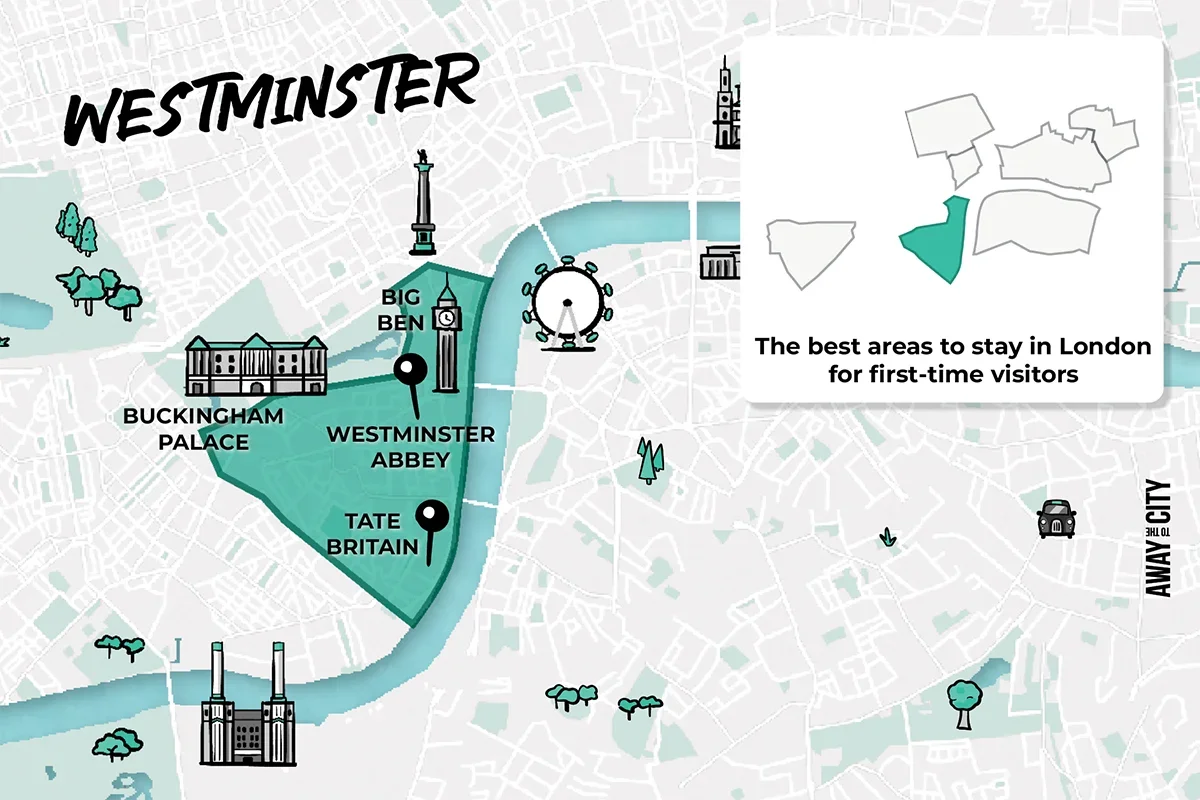
If you want to feel the full weight of London's history from your hotel door, Westminster is the answer: royals, politicians, and enough monuments to fill ten history books.
It’s been the political heart of England since the 13th century, and even after living in London for over ten years, we still find that history impossible to ignore when we’re there.
The streets feel different here to anywhere else in London. They're grand and wide, lined with buildings that were clearly built to impress.

It sits right on the Thames, and the views across to South Bank are some of the best in the city. It's also one of the safer parts of London, with a noticeable police and security presence throughout.
If your trip is one or two days and you want to be close to everything classic London, we think this is one of the best areas to base yourself.
Iconic landmarks like Buckingham Palace, Big Ben, Westminster Abbey, and Trafalgar Square are all reachable on foot from wherever you're staying.

The honest trade-off is that Westminster doesn't have much of a local feel, because not many Londoners actually live here. During the day, it's busy with lobbyists, workers, and tourists.
By evening, it empties out surprisingly quickly. We find it a little sterile for a longer stay. Once you've seen the sights, you've seen the sights, and you're surrounded by a lot of other people doing the same thing.
But for one or two nights with sightseeing as the main goal? Westminster is hard to beat!
Our recommended stays in Westminster
Riu Plaza London The Westminster ($$) – Friends stayed here and said the room felt so well-designed they'd genuinely live in it. We went to visit them, and it convinced us too. Quiet side street, easy walk to Westminster Abbey and the river.
The Trafalgar St. James by Hilton ($$$) – We stayed here for a work trip once, and the view from the room over Trafalgar Square genuinely made the trip. We sometimes meet friends at their Rockwell Bistro for fancy cocktails and live music.
hub by Premier Inn Westminster ($) – Rooms are small (one of our readers called it a cruise ship cabin), but you're five minutes from Big Ben for a fraction of what this postcode normally costs. Sometimes the location really is enough.
3. Covent Garden
Best area for: West End theatre, street performers, and central London energy.
Pros
Cons
If London has a beating heart, this is it. Covent Garden is by far one of the most touristy parts of the city, and we say that not as a warning but as a description.
The West End is loud, bright, and full of life. Staying here puts you right in the middle of all of it.
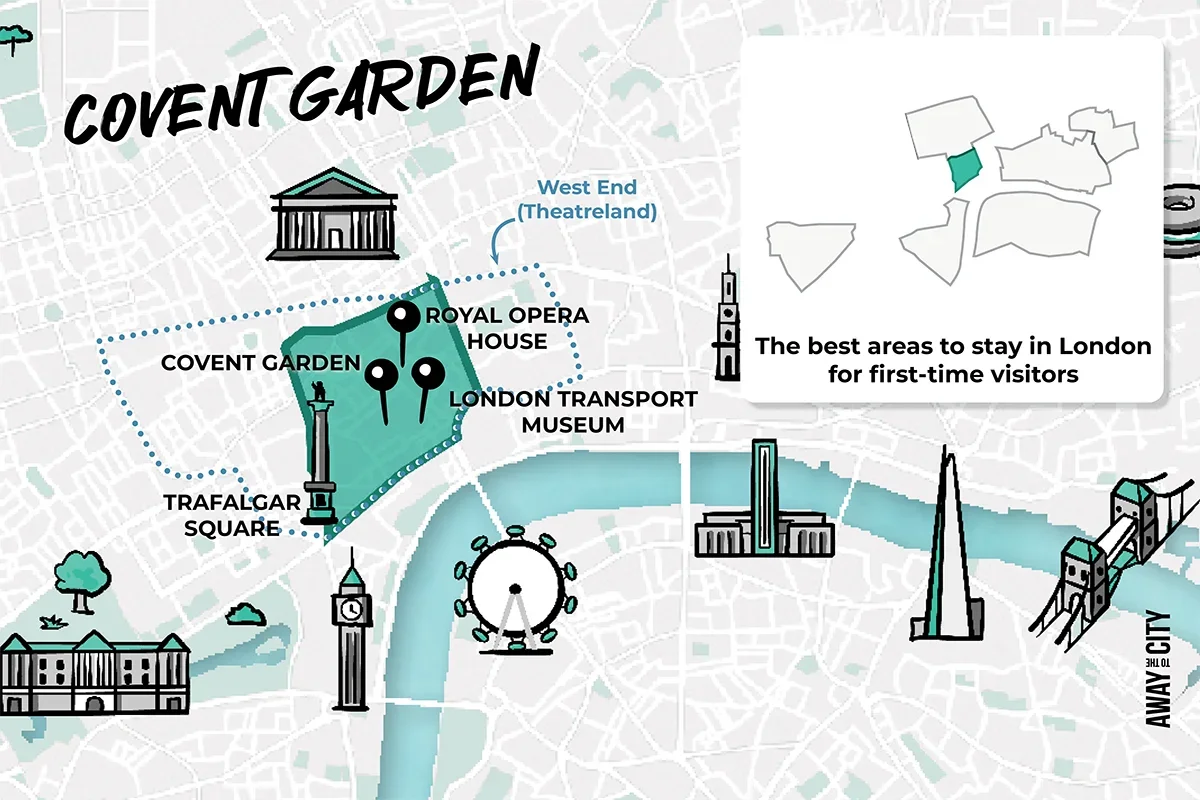
It's also one of the most charming parts of central London, which isn't something you can say about much of the West End.
You'll find cobblestone streets, a mix of architectural styles, street performers, and market stalls dating back to the 17th century. Hard to believe it was still a working fruit and vegetable market until 1974.
It's polished and a bit posh now, but the character is still very much there.

You won't get more central than this. The British Museum, Trafalgar Square, Leicester Square, the Royal Opera House, and some of London's best theatres are all within easy walking distance.
If you love musicals and West End shows (and we absolutely do!), this is the obvious base.

The trade-off is that quaint and quiet are not words anyone would use to describe Covent Garden. It gets very crowded, especially on weekends, and don't expect much of a local or residential feel.
It's also one of the pricier areas to stay. At Christmas though, Covent Garden is magical. Expensive without a doubt… but magical!
Our recommended stays in Covent Garden
The Resident Covent Garden ($$) – No restaurant on site, but Covent Garden has no shortage of great ones. Friends stayed and raved about how quiet the room was despite being right on the Strand, and the mini kitchen made it feel more like a flat than a hotel room.
Middle Eight ($$$) – A gorgeous five-star hotel with suites that are named after famous songs, and its basement bar has live music three nights a week. The bathrobes are so good that one of our readers asked if he could buy one (he couldn't).
The Z Hotel Holborn ($) – Small rooms, but our readers consistently recommend it, and we really like that the hotel puts on a free wine and cheese night on Tuesday and Saturday evenings. Two minutes from Holborn tube, and a short walk to Covent Garden.
4. South Kensington
Best area for: free world-class museums and grand Victorian streets.
Pros
Cons
South Kensington is one of the most refined parts of London.
It has something of a Parisian feel, with wide streets, grand Victorian architecture, and pretty mews (cobblestone alleyways) hidden behind the main roads. This area always makes us want to slow down and wander.
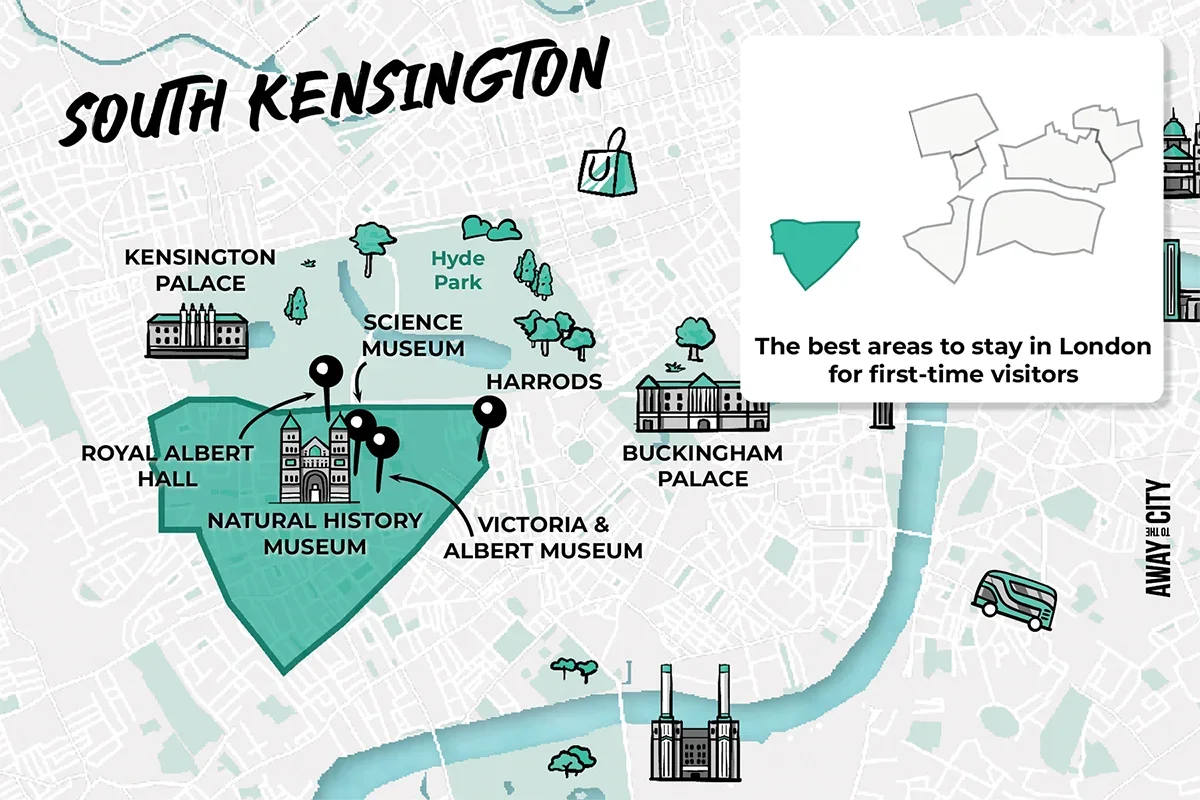
World-class museums like the Natural History Museum, the Victoria and Albert Museum (V&A), the Science Museum, and the Royal Albert Hall are all here, which tells you a lot about the kind of area this is.
Plus, Hyde Park and Kensington Gardens are on the doorstep, and Kensington Palace is minutes away.
We walk through South Kensington regularly because it's one of the most beautiful parts of the city. It's also one of the most celebrity-spotted postcodes in the city.
We've bumped into Rowan Atkinson (Mr Bean) and Idris Elba on separate occasions. Well, that's a completely normal afternoon in South Kensington.

The hotels here skew towards the luxurious end of the spectrum. This is the right base if you want a stylish, quieter stay just outside the centre of London and you're happy to pay for it.
The trade-off is the distance and the price. Anyone after urban grit or edge will find it too buttoned up (Shoreditch or South Bank will suit you better). And if your trip is short and you want to be right in the thick of it, the extra tube stops will start to feel like a cost.
But for a longer stay, or for anyone who wants classic London at its most beautiful? This is it.
Our recommended stays in South Kensington
The Bailey's Hotel Kensington ($$) – Several of our readers have stayed here and really liked it. A lovely Victorian building directly opposite Gloucester Road tube, with a magnificent staircase, stained-glass windows, and tea and biscuits brought to your room every day.
The Ampersand Hotel ($$$) – Every room is themed around one of the South Kensington museums: ornithology, botany, astronomy. We also did their Science Afternoon Tea, and it was completely unlike anything we've had before.
YHA London Earl's Court ($) – A hostel on a quiet residential street with a courtyard garden. Private rooms available alongside dorms, and as YHA is a registered charity, staying here helps fund their Breaks for Kids programme for disadvantaged young people.
5. City of London
Best area for: history, skyline architecture, and London's best free rooftop views.
Pros
Cons
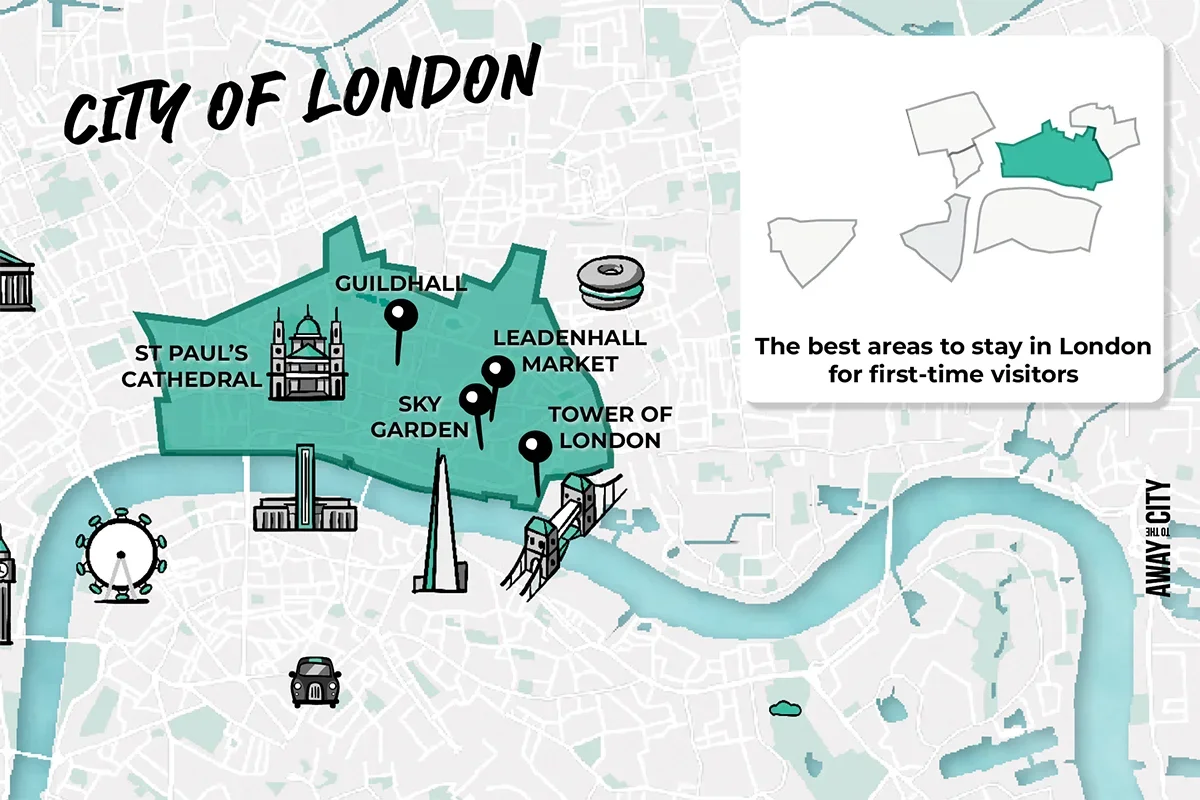
First things first: the City of London is one of London's neighbourhoods, not London as a whole. Confusing? We know.
This one-square-mile area (the Square Mile, as it's known) sits in the east of central London and is easy to miss on a map if you don't know what you're looking for.

We know it well. We both had corporate jobs here for years, and we spent a lot of time wandering these streets.
The thing that gets us every time is how much of a contradiction it is. This is the oldest part of London, and yet somehow also one of the most modern.
One minute you're walking past Roman ruins, the next there's a glass skyscraper right above you. It really is quite strange, and we mean that as a compliment.

On warm weekday afternoons, the Square Mile comes alive. Workers pour out of offices and head to the nearest pub, pints in hand, standing on the pavement (or the curb, as we'd say) with their mates. We did exactly that for years.
Weekends are a different story. The workers leave, and what remains is a peaceful, almost eerily quiet urban village. Only tourists and the occasional jogger. We don't mind that at all, but it's worth knowing before you book.


Our top tip: The City has some of the best free rooftop views in London. Sky Garden, the Garden at 120, and Horizon 22 are all free to visit but require booking in advance.

It's a popular base for business travellers, and for good reason. Transport links here are exceptional.
And while it's not the most charming of London's neighbourhoods, it is among the most convenient, with St. Paul's Cathedral, the Tower of London, and Tower Bridge all within easy reach.
Our recommended stays in the City of London
Apex City of London Hotel ($$) – We stayed here while moving, and it's a genuine hidden gem: down a quiet lane in the City, with an incredible breakfast buffet, and completely peaceful despite being steps from Tower Hill tube and the Tower of London.
Pan Pacific London ($$$) – We stayed at the Pan Pacific Orchard in Singapore, and it was one of the best hotel stays we've ever had. The London outpost has the same standards: an infinity pool perfect for morning swims and the incredible Straits Kitchen restaurant.
Motel One London Tower Hill ($) – A German budget-design chain we've stayed at in multiple countries, always the same: stylish turquoise-and-wood interiors, clean modern rooms, and a cosy lobby with a bar and coffee station. Great value for the location.
6. Shoreditch/Spitalfields
Best area for: street art, creative energy, and East London's best market scene.
Pros
Cons
No area in London has reinvented itself quite like the Shoreditch/Spitalfields area. It's gritty and raw, a mix of East End edge and modern creativity that you don't really find anywhere else in the city.
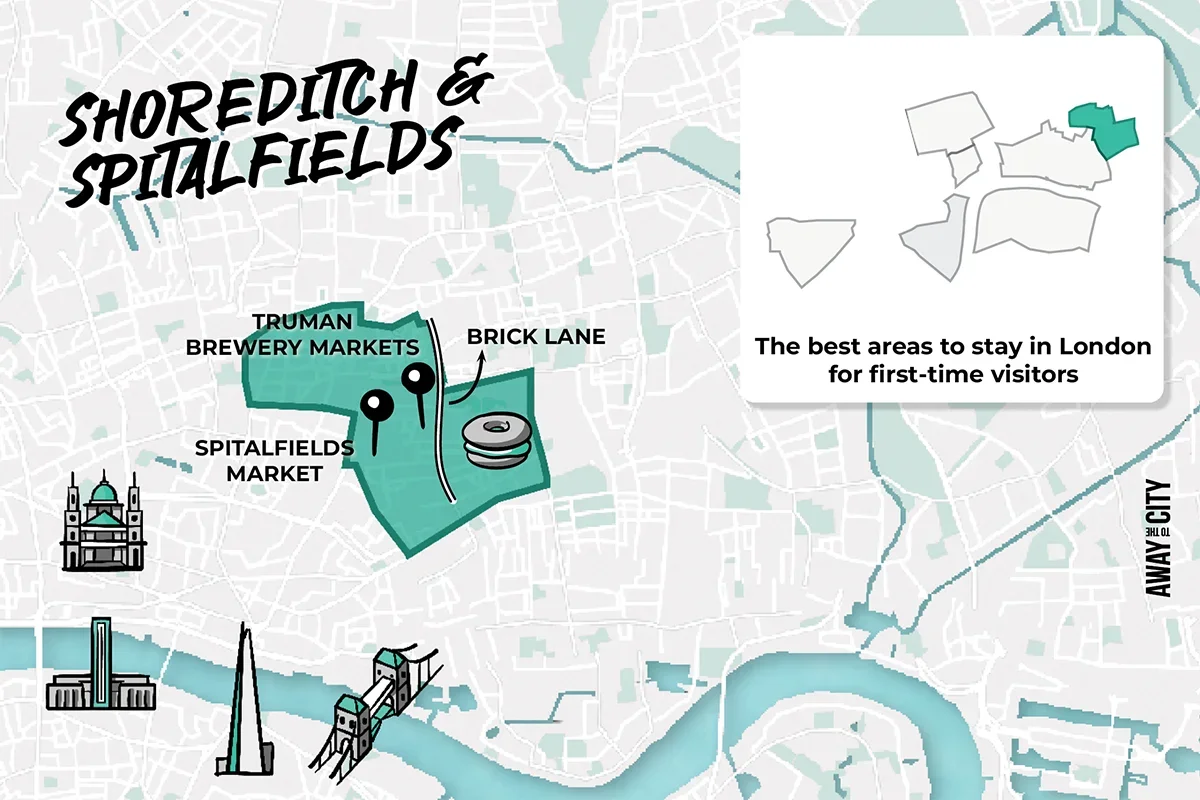
It's a huge hub for artists, designers, and entrepreneurs, and that energy is visible everywhere.
The street art covers almost every wall, independent businesses line the side streets, and the density of vintage stores is unlike anything we've seen in any other city.

Brick Lane is one of the neighbourhood's main streets, and it's become something of a cultural landmark in its own right. The lane is full of street art, vintage shops, and bagel shops that have been there for decades.
We love grabbing one from the Beigel Shop on our way through. Salt beef is the classic order, but there are plenty of other options (including vegetarian ones).

Spitalfields Market is worth a morning of your time, whether you stay in the area or not. It's where history meets hipster, bespoke suits sit alongside indie boutiques, and the street food stalls are some of the best in London.
The Sunday Upmarket on Brick Lane takes it further, with food from every corner of the world.
We'll be honest, we're not big nightlife people ourselves. But several friends who know London’s nightlife well say Shoreditch is one of the city’s best areas for it.
You’ll find everything from quirky cocktail bars to underground clubs here, and you mainly mix with locals rather than tourists.

It's busy, loud, and boisterous at night, which is either the appeal or the trade-off depending on who you are.
Since it's slightly further from the centre than areas like Covent Garden or Westminster, hotels here tend to be noticeably better value. It's still well-connected by tube, so getting around is easy.
Our recommended stays in Shoreditch & Spitalfields
citizenM London Shoreditch ($$) – We love citizenM and have stayed at their stylish hotels across the world. The one downside is that you can only get into the bed from one side, but it's one of the most comfortable beds we've slept in anywhere, so it's a compromise we're fine with.
Aethos London Shoreditch ($$$) – A Swiss boutique group's first UK outpost, opened in October 2025. Beautifully designed rooms, a complimentary cake and sake waiting on arrival, and walking distance from some of the best restaurants and bars in East London.
ibis London City Shoreditch ($) – Several friends have stayed here and were all surprised by how quiet the rooms were, which in Shoreditch is not something you'd expect. Literally on the corner of Aldgate East tube, with a good value breakfast.
7. Bloomsbury/Fitzrovia
Best area for: the British Museum, quieter streets, and Charlotte Street restaurants.
Pros
Cons
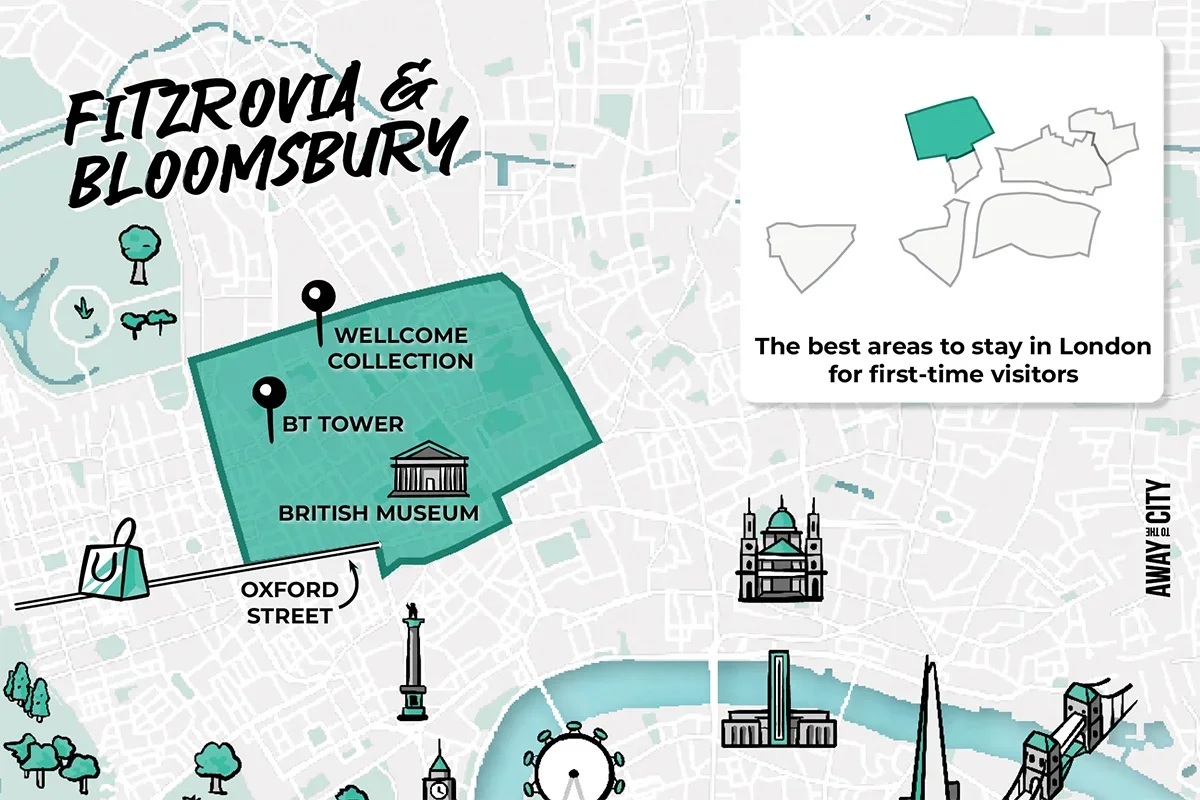
Bloomsbury and Fitzrovia are two of the most underrated areas in central London, and two we know particularly well. We spent two years working in offices in Fitzrovia.
What we love most about this part of the city is how it manages to feel local despite being right in the centre. It's full of leafy garden squares, tree-lined streets, and independent cafes.

Don't underestimate those garden squares either. Visitors tend to focus on Hyde Park or Regent's Park, but these smaller green oases dotted around Bloomsbury are one of the area's quiet pleasures.
We've spent more lunch breaks than we can count in them.

The area has a strong literary and intellectual identity, home to several universities and the British Museum (one of the largest museums in the world). The student presence keeps it young and lively at night, which we really liked.
Fitzrovia's Charlotte Street is one of London's best dining streets, with restaurants covering everything from Greek to Japanese.
Plus, Covent Garden, Soho, and Oxford Street are all within easy walking distance.

In our opinion, it's not as visually grand as South Kensington or as immediately striking as Westminster.
But if Shoreditch feels too edgy and Covent Garden feels too touristy, Bloomsbury and Fitzrovia are the middle ground we'd point you to. It has good-value hotels, excellent transport links, and a quieter kind of London that still has everything within reach.
Our recommended stays in Bloomsbury & Fitzrovia
NYX Hotel London Holborn ($$) – We stayed here while moving, and the pool and sauna were a proper welcome break (included in our stay). Plus, they have a rooftop bar, a great breakfast with a made-to-order omelette station, and rooms that are genuinely spacious by London standards.
Kimpton Fitzroy London ($$$) – One of the most iconic buildings in London, and it's been on our anniversary list for years. Designed by the same architect as the Titanic's dining room, there's a bronze dragon on the stairs, with an identical copy on the Titanic.
Keystone House ($) – One of our frequent London readers loves this for the location and price: steps from King's Cross and St Pancras, perfect for an early Eurostar. The road outside is a bit noisy, but they leave earplugs in the room.
Other Popular Neighbourhoods in London
We get asked about a few other London neighbourhoods a lot, so here's our honest take on each.
Soho

Brixton
Notting Hill

Mayfair/Marylebone

Greenwich

FAQ: Areas in London
When it comes to where to stay in London, a few questions come up again and again. Here are the ones we get asked most.
What's the best area to stay in London for first-time visitors?
South Bank/Southwark is our top pick. It's central, walkable, and better value than the West End for similarly located hotels. Westminster is our runner-up if being steps from Big Ben and Buckingham Palace is the priority. Both are safe, well-connected by tube, and easy to navigate on foot.
Is it worth staying in central London?
Yes, especially for a first visit. London is large, and its attractions are spread out, so staying in Zone 1 means more time exploring and less time commuting. The cost is higher than staying further out, but for a short trip, the time saving is worth it.
What is the cheapest area to stay in London?
Most genuinely budget-friendly areas in London (Stratford, Croydon, Wembley) are far from the centre and involve long commutes. If you want to stay central on a tighter budget, Shoreditch/Spitalfields are the best options from the areas in this guide, with hotel prices noticeably lower than the West End and good tube links throughout.
How far in advance should you book a hotel in London?
Book at least 3 months ahead where possible, and at least 6 months ahead for summer (June-August), Christmas, or major events. London hotels fill faster than almost any other city in Europe, and the best-value options go first.

Let’s lock in the rest of your London plans
Hopefully this has made the neighbourhood decision feel a lot more manageable. The South Bank/Southwark area is where we'd start, but every area in this guide has a genuine reason to be here.
If you haven't booked your hotel yet, The Hoxton Southwark is the one we'd go back to without hesitating. After 30+ London hotel stays, it's still our favourite in the city. The warehouse-style windows that flood the rooms with light are something we still think about.
Now that your base is sorted, the next step is getting ahead of the queues. Our must-book London attractions guide covers everything worth pre-booking so you're not losing half a day to a ticket line.
And if your trip falls later in the year, our festive London guide is worth a read before you finalise your plans.
London rewards people who show up prepared. Hope to see you on the South Bank!
Save this post for later:


🇬🇧 Plan your London trip with our guides