Gyeongju Day Trip from Busan: The Easiest Way to Visit
This post may contain affiliate links, including from Amazon and other trusted partners. If you click a link and make a purchase, we may earn a small commission at no extra cost to you. That said, we only recommend products and services we genuinely use and love. Learn more in our Privacy Policy page.


We knew long before our Busan trip that we wanted to visit Gyeongju. The problem was finding the time.
We'd been to South Korea four times and visited several cities, but we'd never managed to make it to Gyeongju. This time, we had exactly one spare day in our Busan itinerary and decided it was now or never.
When we told our friend in Seoul we were planning a Gyeongju day trip from Busan, she was genuinely surprised. “One day?” she asked. “You really need at least two or three.”
That got us wondering. Was one day enough? Should we book a guided tour or try to do it independently?
Now that we've done it, we can confidently say that one day is enough to see the highlights, and we'd do it again without hesitation. We booked a guided Gyeongju tour from Busan and managed to see far more than we expected in a single day.
If you're wondering how to get from Busan to Gyeongju, whether a guided tour is worth it, and what you can realistically see in a day, this guide will walk you through exactly what we did and what we'd recommend.

Why is Gyeongju worth a day trip from Busan?
Gyeongju was the capital of the Silla Kingdom for nearly 1,000 years and is often called a “museum without walls”. It's about an hour from Busan, and as a UNESCO World Heritage Site, the area is packed with centuries-old temples, royal tombs, and palace ruins.
We've visited Seoul, Busan, and a handful of other Korean cities. And what makes Gyeongju unlike anywhere else in the country is that the ancient world is right there in the middle of a living city.
You walk through a modern street lined with cafés and boutique shops, turn a corner, and realise the grassy hills around you are actually royal burial mounds.


There are no high-rises pushing through the skyline, and the traditional hanok architecture runs throughout. The whole city feels coherent in a way that most Korean cities (with their mix of old and very new) simply don't.
Hwangnidan Street captures this well. It's a neighbourhood of hanok buildings that now houses speciality coffee shops, independent boutiques, and street food stalls. It's lively and modern, but it doesn't feel like it belongs somewhere else.
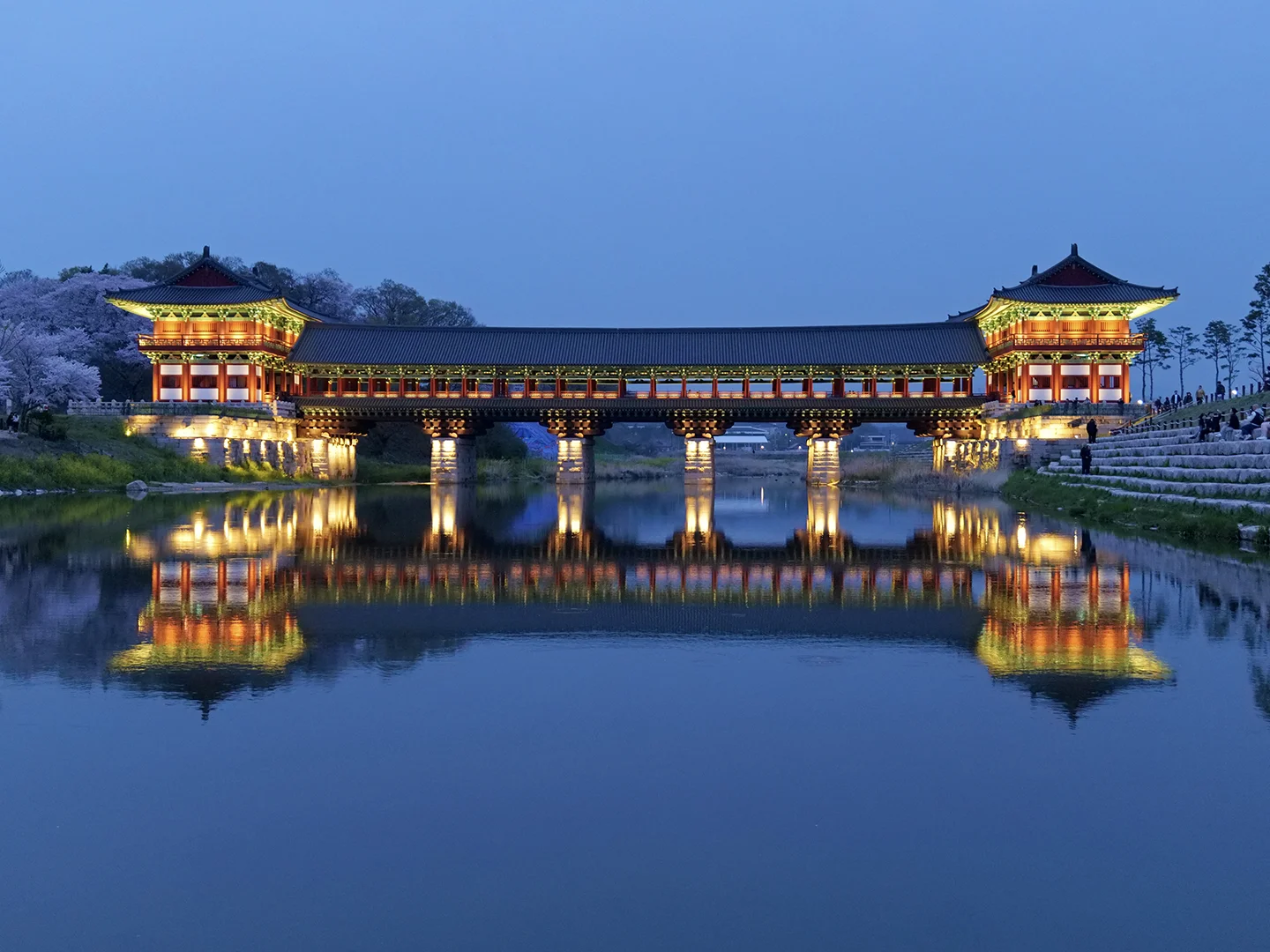
After dark, Woljeong Bridge and Donggung Palace reflect on the water… it looks very magical! Don't leave before the lights come on.

We only had a day in Gyeongju, and it ended up being one of our favourite parts of our Korea trip. We booked this guided Gyeongju day trip from Busan, and it was the easiest way to see as much as we did in a single day.
To be honest, Gyeongju deserves longer than a day, but even a single day is absolutely worth visiting. And we're already planning to go back and stay overnight next time.
How do you get from Busan to Gyeongju?
Gyeongju is about 80 km (50 miles) from Busan and takes around 30-60 minutes depending on how you travel. The three main options are the KTX high-speed train, the express bus, and a guided tour.

The KTX only really makes sense if you're staying near Busan Station itself. If you're staying in Haeundae (the best area to stay in Busan, and where you'll find our favourite hotel, the L7 Haeundae by Lotte), the bus is the smarter choice.
Getting to Busan Station for the KTX adds roughly 40 minutes each way, and the Haeundae Intercity Bus Terminal puts you on a direct service without crossing the city.

South Korean buses are genuinely impressive too. They’re modern, clean, and far more comfortable than you might expect.
For taxis, use the K.ride app rather than Kakao T. Kakao T regularly rejects foreign credit cards, which we found out the hard way after a ride in Seoul.
K.ride is the official global version of Kakao T, which solves this by accepting international credit cards and phone numbers.
Tour or self-guided: which is better for one day?
For a one-day trip from Busan to Gyeongju, we'd recommend a guided tour. It covers more ground, includes historical context from an English-speaking guide, and handles all the transport between the major UNESCO sites.
Going independently works better if you want to focus on Gyeongju's cafe and food scene or have two days.
We generally prefer exploring on our own, but there are places where a guided tour just makes more sense. And Gyeongju is one of them.

We'd actually started mapping out an independent route before we booked. Once we added up the transit times between sites, it became obvious we'd spend more of the day on buses than actually seeing anything.
Even though it's a small city, there's a lot to see, and some of the sites are more spread out than you'd think. Bulguksa Temple is a 30-minute drive from the centre.
That doesn't sound like much on its own. But add in the travel time from Busan, a bus or taxi into the city centre, and then another out to the temple, and you end up spending more of the day on transport than actually seeing things.

On top of that, Donggung Palace after dark (one of the highlights of our trip) only works if you're still in the city after sunset. Most independent visitors realistically head back to the station before then.
The Gyeongju tour we took handled all of that. And having a guide made a big difference to our experience.
Since Gyeongju was the capital of the Silla Kingdom, a lot of what you're looking at only makes sense once you understand that background.
We overheard a couple at the burial mounds who weren't on a tour saying they didn't get what was special about the tombs. Meanwhile our guide was explaining which Silla kings were buried where and how the mounds were constructed.
We were really glad we did this one as a guided tour.


That said, if your priority is food and coffee rather than history, skip the tour.
Hwangnidan Street has a brilliant speciality coffee scene, independent shops, and some of the best street food we had in South Korea. You'll want a full afternoon there without a schedule pulling you away.
What our Gyeongju day trip actually looked like
We booked this exact full-day Gyeongju UNESCO tour run by TOURSTORY Korea, which includes an English-speaking guide throughout the day, and we'd book the same one again.
There's also a shorter “express version” that covers just three stops in around six hours. But we'd skip the express package. You'd miss Daereungwon Tomb Complex and Hwangnidan Street, and those two are among the best parts of the day.

The full tour runs about 11-12 hours from Haeundae Station (depending on traffic), which sounds long, but the day moves quickly.
Here's what the day actually looked like:
1. Yangdong Folk Village
This was our first stop of the day. Yangdong Folk Village is home to around 150 well-preserved hanoks from the 15th-century Joseon Dynasty, and our guide brought the whole place to life.

Even the layout of the village tells a story. Higher ground meant higher social status during the Joseon period, and our guide connected that to modern Korean culture in a way that made it feel relevant rather than like a history lesson.
We had lunch here in a local restaurant. We pre-ordered from a menu on the bus, so when we arrived, everything was already on the table.
It was a traditional Korean meal, nothing fancy, but a good match for the setting. If you're a vegetarian or have specific dietary requirements, you might want to bring snacks. The options were limited.

We'd already visited the Korean Folk Village near Seoul, so some of this felt familiar. But Yangdong is a real working village, not an open-air museum. It's quieter, less staged, and more lived-in.
We're glad we saw it, and it's not something you'd easily find on a self-guided day trip.
2. Bulguksa Temple
If you're tempted to skip this one because you think you've seen enough temples in South Korea, don't!
Bulguksa was once the heart of the Silla Kingdom, and it was designed to represent the land of Buddha, so it's quite special. It's one of the first images most people think of when they hear Gyeongju.

We visited on a Tuesday, and the grounds were quiet. We could even hear the sound of birds.
Every building we walked past had different architectural details and carvings, and we kept stopping to look at things we'd have walked straight past at a busier site.


The 33 steps leading up to the temple each represent a stage on the path to enlightenment. Our guide explained how the symmetry, the balance, and the entire layout of the complex all reflect Buddhist teachings about harmony.

It's a UNESCO World Heritage Site and one of the most impressive temples we've seen in all of South Korea.
3. Daereungwon Tomb Complex
One of the most unique things about Gyeongju is that there are royal tombs everywhere… and we mean EVERYWHERE.
The tombs look like rolling green hills in a park and (funnily enough) reminded us a bit of the Teletubbies landscape.

What you're actually looking at are royal burial mounds from the Silla Kingdom, right in the middle of the city.
One tomb has been excavated and turned into a small museum. It was included in the tour and gave us a really good idea of what's under the royal tombs.
This is exactly where we overheard that couple saying the tombs were boring. Without our guide, we probably would have felt the same.


We also walked over to Cheomseongdae Observatory, which is nearby.
It's often described as the oldest surviving astronomical observatory in East Asia, but the stone tower is only about 9 metres (30 feet) tall and there’s really not much to see.
Honestly, we'd skip it next time and spend that time in Hwangnidan instead.
4. Hwangnidan Street
We had about 1.5 hours of free time here, but could easily have spent 4 hours or more at Hwangnidan Street.
Hwangnidan is an entire neighbourhood of hanok buildings now filled with cafés, restaurants, boutiques, and bookshops.
It reminded us of what they've done with Ikseon-dong in Seoul, but less crowded and with more space to breathe.


We walked the main road first, then headed into the smaller alleys, which were even better. They were quieter, more interesting, and full of tiny speciality coffee shops we wished we'd had time to sit down in.

We tried Gyeongju bread (also called Hwangnam bread), a small pastry filled with red bean paste that's been baked here since 1939.
Worth trying for the experience, though if you've had red bean pastries elsewhere in Korea, the taste won't be a revelation.
If we went back to Gyeongju independently, we'd give this area a full afternoon.
5. Woljeong Bridge
This historic bridge lights up after dark, and the reflections on the water were one of our favourite visuals of the entire trip. It's a really peaceful spot too, especially compared to the busier parts of the day.

We only had a short stop here, but honestly, it was enough.
Woljeong Bridge was first built in AD 760, collapsed during the Joseon Dynasty, and was fully rebuilt in traditional style in 2018.

6. Donggung Palace & Wolji Pond
We ended the day here, and the timing was perfect. We arrived when it was all beautifully lit, and the reflections in the pond were exactly as good as the photos make them look. Maybe better, because it was so quiet.

There isn't a huge amount to see in terms of structures. The original palace buildings are gone, but some of the pavilions have been reconstructed, and there's a pond and some relics.
We'd seen daytime photos before our trip and they looked rather… bland.
Nothing that would have made us rearrange our schedule. The evening version is a completely different experience, and it's the reason we keep saying don't leave Gyeongju before dark.

The lit-up pavilions reflecting on the still water were the best thing we saw all day. We were the last ones back to the coach.
It was a perfect end to one of our favourite days in South Korea. Looking back, our guided Gyeongju day trip covered more ground than we could have managed on our own, and we didn't have to think about transport once.
What about doing Gyeongju independently?
If you'd rather explore at your own pace, going independently is a good option.
Here's how we'd structure our one-day Gyeongju itinerary:
Give yourself as much time as possible at Hwangnidan. And don't head back to Busan before dark. Donggung Palace after dark is the best thing in Gyeongju, and it's rather bland in daylight.
This is doable in one day, but it's tight. You'll cover fewer sites than on a guided tour, and you won't have a guide to give you the historical context at each stop.

If you can stay overnight, the pace becomes much more relaxed, and you can add Seokguram Grotto and Gyochon Traditional Village to the list.
As we mentioned earlier, for navigation, use Naver Map rather than Google Maps. For taxis, use K.ride rather than Kakao T. Both are essential South Korea travel apps you should install before you go.
Our top tips for your Gyeongju day trip
 Tip 1 – Book in advance: Reserve your Gyeongju day trip BEFORE you arrive in Busan. We booked ours when we were already in Busan, and most dates were already fully booked. We were glad that we had an entire week there and eventually got one of the last spots. The Gyeongju tour is one of the Busan things you need to pre-book. And if you're visiting during cherry blossom season or on a spring or autumn weekend, book even earlier.
Tip 2 – Go on a weekday: Gyeongju is a popular destination for domestic tourists and school trips, and major attractions will be noticeably busier on weekends and holidays. Our tour guide told us she much prefers the weekday tours because of the weekend crowds.
Tip 3 – Give yourself a full day: Many day tours from Busan run 10-12 hours and return in the evening, which shows you how much there is to see. Even on the guided tour, the day moved quickly. If you're going independently, start as early as possible. The more time you have in Gyeongju, the better.
Tip 4 – Wear proper shoes: There are stone steps and uneven paths throughout, and you'll cover a lot of ground between sites. Trainers are ideal.
Tip 5 – Bring snacks and water: Lunch on the tour is at your own expense, breaks between stops are limited, and convenience stores aren't always located right beside the major sights. We grabbed the 10-won coin snack filled with mozzarella at Hwangnidan and would highly recommend it.
Tip 6 – Pack a layer for the evening: The temperature drops noticeably after dark, and the best stops of the day (Woljeong Bridge and Donggung Palace) are both in the evening. A light jacket makes a big difference.
Tip 7 – Bring your T-Money card: If you're exploring independently and planning to use local buses, make sure your T-Money card has enough credit before setting off. Gyeongju's bus network reaches most major attractions, including Bulguksa.

FAQ: Day trip to Gyeongju
We get a lot of questions about visiting Gyeongju from Busan. Here are the ones that come up most often, with straight answers based on our own experience.
Can you do a day trip from Busan to Gyeongju?
Yes, and it's one of the best day trips from Busan. The journey takes around 30-60 minutes depending on how you travel. You can take the KTX, the express bus, or join a guided tour. With a full-day guided tour, you can cover the major historic sites and still be back in Busan by late evening.
How many days should I spend in Gyeongju?
Two days is ideal. One full day with a guided tour covers the highlights well and gives you a really good taste of the city, but Gyeongju deserves more time than that. A second day lets you explore at your own pace, linger at Hwangnidan Street, and visit sites like Seokguram Grotto without rushing.

How far is Gyeongju from Busan?
Gyeongju is about 80 km (50 miles) from Busan depending on your route. By KTX it takes around 30 minutes, by express bus about 50-60 minutes, and by car roughly an hour. It's close enough for a very comfortable day trip.
What is the easiest way to do a day trip from Busan to Gyeongju?
The easiest way to do a Gyeongju day trip from Busan is via a guided tour. A coach picks you up in Busan, handles all transport between sites, and includes an English-speaking guide throughout the day. This is especially useful for reaching outlying sites like Bulguksa Temple, which is difficult to get to independently without losing significant time.
What are the must-see attractions in Gyeongju if I only have one day?
Bulguksa Temple, Daereungwon Tomb Complex, Hwangnidan Street, Woljeong Bridge, and Donggung Palace and Wolji Pond are the highlights. The first four are spread across the city, so plan your route carefully. And whatever you do, make sure you're still in Gyeongju after dark. Donggung Palace and Woljeong Bridge are both far better illuminated at night.
Before you leave for Busan
We've been to more than 450 cities all around the world, and Gyeongju is one of our favourite cities in South Korea.
We loved the tombs in the middle of the city, the Hwangnidan alleys we didn't want to leave, and being the last ones back to the coach at Donggung Palace.
If you can spare a day from your Busan itinerary, Gyeongju is the one we'd use it on. And if we were planning our Busan trip again, this exact Gyeongju guided tour would be one of the first things we'd lock in.
For everything else Busan has to offer, our guide with the best things to do in Busan covers the highlights we'd put on any first-time itinerary.
And if you're still figuring out where to base yourself, you might want to start with these Busan neighbourhoods and hotels.
🇰🇷 Plan your South Korea trip with our guides
📍 South Korea essentials
📍 Seoul
📍 Busan